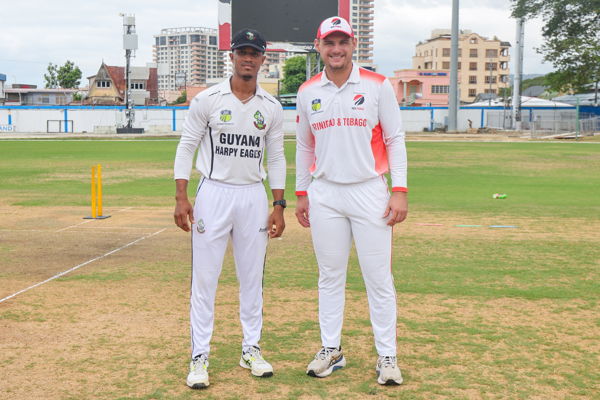
Coaches Banking on Clinical Execution from Players in Revised West Indies Championship

ST JOHN’S, Antigua- The first day of the West Indies Championship bowled off on Sunday, bringing with it a sense of anticipation among coaches and management staff from the teams involved in the revised format.
This year’s tournament will feature each team playing a three-match bilateral series. The team that accumulates the most points across these series will advance directly to the final, while the second- and third-placed teams will compete in a playoff for the remaining spot.

The Guyana Harpy Eagles, winners of the last three championships, return as strong contenders. Head coach Ryan Hercules noted that the revised format adds an extra layer of intrigue to the tournament, ultimately raising the level of competition among players.
“Once an opportunity is presented to us as a franchise, we look to develop our younger players by getting them into the system as early as possible,” Hercules said. “With a shorter number of games to play, the players will need to adapt as quickly as possible and use the small window of opportunity to create something special.”
Windward Islands Volcanoes head coach Kenroy Peters is optimistic about his squad, highlighting that the team was built with long-term sustainability in mind.
“Our selections are all about continuity and we realize that as a franchise we need to give our young players who were playing for the Academy and Combined Campuses & Colleges (CCC) teams the opportunity to represent the Windwards well,” Peters explained. “We are looking at a five-year plan, and this is part of the process, and the youngsters that we have entrusted have really started well for us.”
Former West Indies representative Rayad Emrit, who is now the head coach of the Trinidad & Tobago Red Force, is banking on his team’s values in the revised format.
“The guys are professional enough and we understand what we need to do, we come here with one goal in mind, which is to get to the next stage, but to do so we must take it one day at a time.”
Meanwhile, preparation for the Leeward Islands Hurricanes was methodical and strategic, with camps starting in January as part of a structured plan devised by head coach Steve Liburd.
“We started preparing in January doing some technical work, we progressed through the gears, doing nets and scenario-based drills in the last month leading up to the tournament,” Liburd shared. “You enter any elite competition to win first and foremost and then try to get some players into the West Indies team, some who are on the fringes and some who lost their spots are looking to reclaim their positions.”
For Peters, the chance to play in a bilateral series creates an avenue for players to aim for a level of consistency.
“One of the advantages of this bilateral series is that it gives you the opportunity to play the same opposition three times, and it also means that the players can be a bit more relaxed. Our objective is to win this competition for the first time, and the players have the drive and will to do so.”
Liburd weighed-in further on the pros of the tournament.
“Similar to international cricket, you have enough time to strategize and plan even though you are playing at different venues. The pro of this format is that it gives an insight into what international cricket is all about where you play bilateral series against one team and as the game goes on you see how well you can plan for the opposition.”
This sentiment is shared by Hercules, who has overseen Guyana’s last three title wins.
“Seeing the opposition repeatedly, I expect the batters, with the use of our analyst, to understand the bowling lineup that they will face because even if a team make a change, they have about two players on the bench that you can assess and counter their threats quickly.”
Ultimately, the coaches believe that success in the tournament will come down to execution, as they place their trust in players to deliver on their defined roles. While strategies and preparation have laid a solid foundation, it is discipline on the field that will determine outcomes.
END